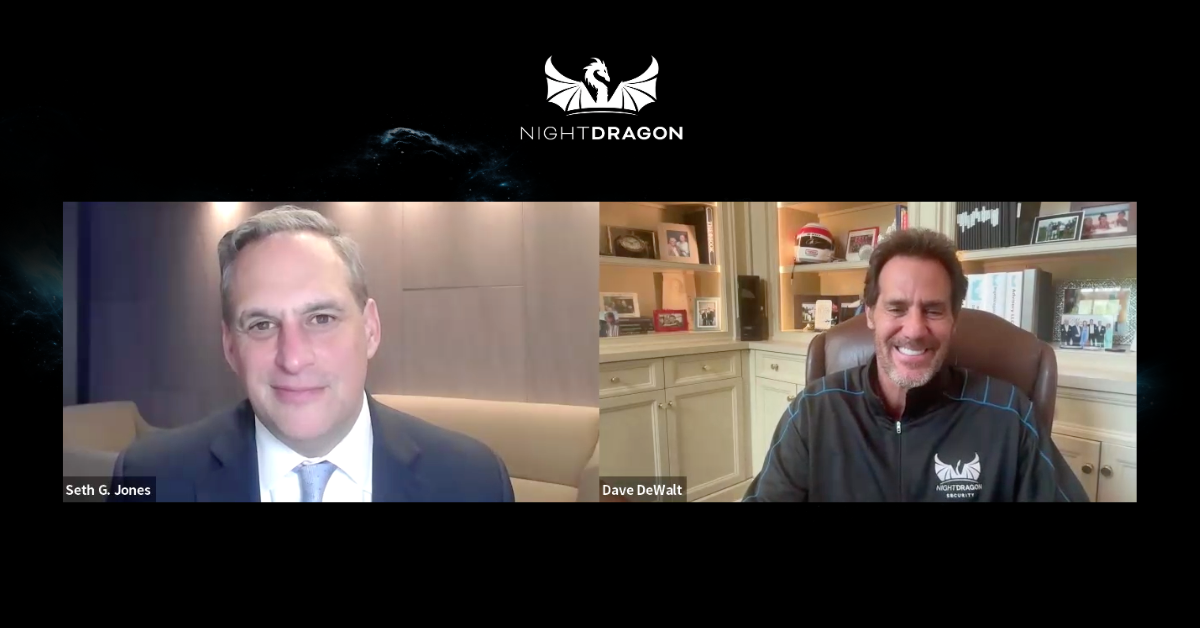
NightDragon kicked off our NightVision series for 2026 with an exceptional conversation featuring Seth G. Jones, a respected voice in U.S. defense, national security, and strategic competition that brings together a rare combination of policy leadership, operational experience, and scholarly rigor.
Jones serves as President of the Defense and Security Department at the Center for Strategic and International Studies (CSIS), where he oversees research spanning military operations, cyber, space, intelligence, irregular warfare, and defense technology. His career includes senior roles within the Office of the Secretary of Defense and U.S. Special Operations Command, multiple deployments tied to Afghanistan, and service on congressionally mandated commissions, including the Afghanistan War Commission.
He is also the author of several influential books, including his newest, The American Edge: The Military Tech Nexus and the Sources of Great Power Dominance, which examines how innovation, industrial capacity, and strategy underpin U.S. power. That perspective anchored a wide-ranging NightVision discussion with NightDragon Founder and CEO Dave DeWalt—one that explored the risks, opportunities, and choices facing the United States as we enter 2026.
Here are some key takeaways from their discussion:
An Axis of Adversaries Is Reshaping the Global Threat Landscape
Jones highlighted the unprecedented level of cooperation among U.S. adversaries, noting that “North Korean troops are in Russia, Iranian drones are being built in Russia, and Chinese components are flowing into the Russian defense industrial base.” This alignment across military, industrial, and technological domains represents a fundamental shift from past decades and complicates the threat landscape. “That cooperation on production, scale, and sustainment is something the U.S. hasn’t faced in quite this way before,” he warned.
China’s Precision-Strike Capability Challenges U.S. Freedom of Action
One of Jones’s greatest concerns is China’s expanding ability to conduct mid- and long-range precision strikes, which complicates U.S. operations in the Taiwan Strait and beyond. “How do you move forces, communicate, and sustain logistics in that environment?” he asked—underscoring the operational dilemma.
Technology Alone Doesn’t Deter—Concepts of Operations Matter
Drawing from history, Jones stressed that innovation must be paired with doctrine. Just as nuclear deterrence and air and land battles shaped earlier eras, today’s technologies must align with concepts like U.S. Indo-Pacific Commander Admiral Samuel Paparo’s emerging “hellscape” approach to effectively deter conflict.
Autonomy and Undersea Capabilities Are U.S. Asymmetric Advantages
Jones pointed to undersea warfare, unmanned systems, and autonomy as areas where the U.S. and its allies retain meaningful advantages. These capabilities exploit Chinese vulnerabilities while enabling intelligence collection, precision effects, and operations with reduced risk to personnel. DeWalt referenced U.S. companies leading in these sectors, including Saronic, Epirus, Forterra, and others.
The U.S. Must Shift from Peacetime to Wartime Industrial Thinking
To rebuild deterrence, Jones argued the U.S. must move beyond a peacetime mindset. “We’re past the ‘last supper’ of defense consolidation—we need a first breakfast,” he said, calling for increased production, streamlined acquisition, and a renewed sense of urgency across government and industry.
Private Capital Is a Game-Changer for Defense Innovation
Unlike past eras, today’s defense ecosystem benefits from massive private-sector investment, which Jones described as a “huge competitive advantage” for the U.S. Venture capital and private equity are accelerating innovation—but must be better aligned with military needs and strategy.
Energy Is the Foundation of Future Military and AI Power
Jones closed by underscoring energy as a critical vulnerability, noting that AI, advanced manufacturing, and industrial revitalization all depend on power generation at scale. “Everything sits on energy,” he said, pointing to China’s production advantage and the need for U.S. action.
As NightVision 2026 gets underway, this conversation served as a powerful reminder: the American edge is real—but it is not guaranteed. Sustaining it will require urgency, partnership, and the ability to translate innovation into deterrence at speed.
Keep an eye out for future NightVision events in 2026, which will feature top leaders in defense, cybersecurity, government and other sectors. A full list of our upcoming events can be found on our Events page.