In the latest installment of NightDragon’s NightVision 2026 series, Founder and CEO Dave DeWalt sat down with Lieutenant General Michelle McGuinness, Australia’s National Cyber Security Coordinator, one of the most influential global cyber leaders. With over 30 years of military service, Lt. Gen. McGuinness leads whole-of-government cybersecurity coordination and incident response from within Australia’s Department of Home Affairs.
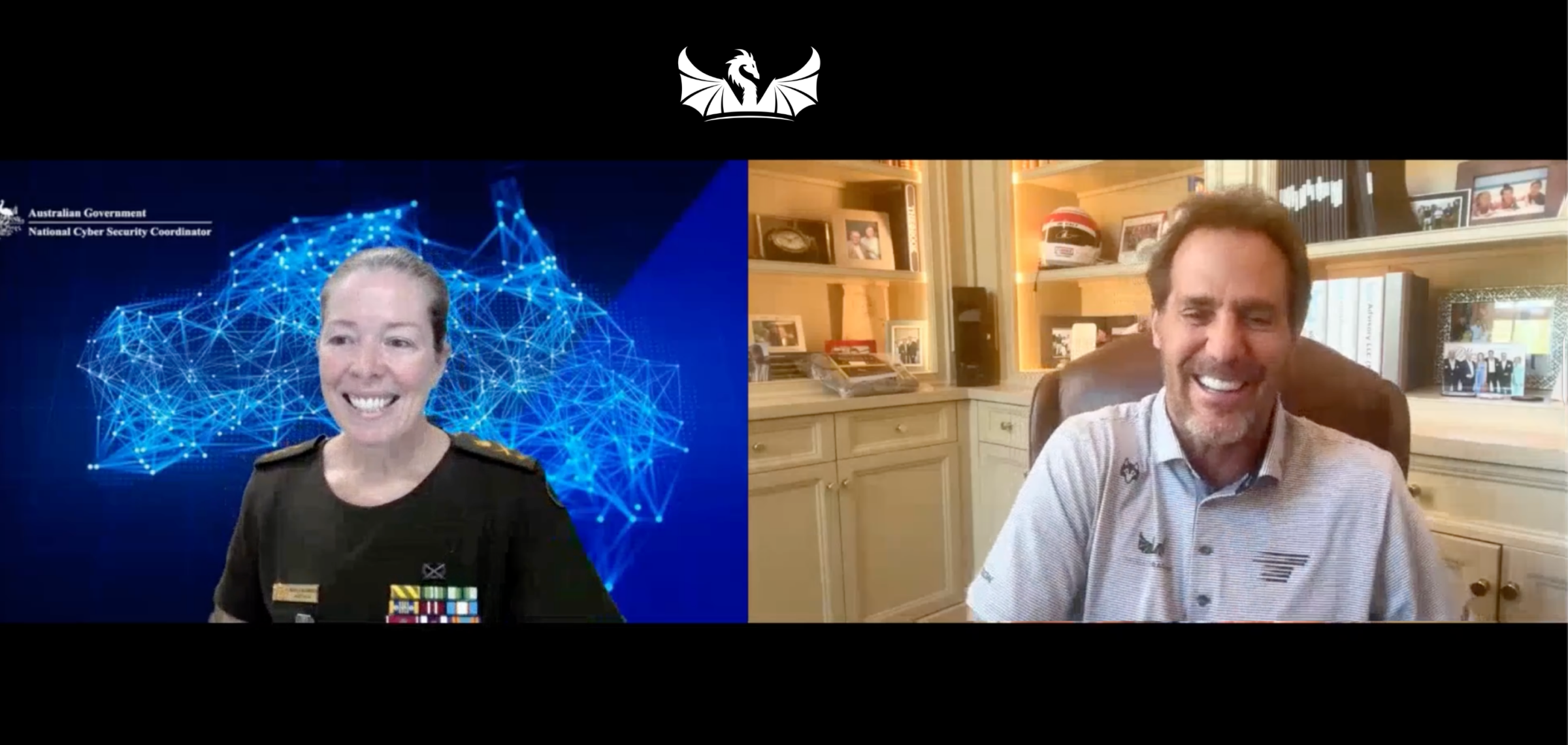
The conversation covered the shifting global threat environment, geopolitical escalation, OT vulnerabilities, AI’s double-edged impact, and Australia’s growing sovereign cyber capability.
Here are some key highlights from their conversation. Tune into the full NightVision discussion recording below to hear the entire exchange.
State Actors Have Shifted from Espionage to Pre-Positioned Disruption
The most consequential change in the threat landscape isn’t the volume of attacks – it’s their intent. Lt. Gen. Michelle McGuinness described a clear shift from traditional espionage toward deliberate pre-placement: threat actors burrowing into critical systems to disrupt or destroy services at times and places of their choosing, echoing the Salt Typhoon and Volt Typhoon campaigns that DeWalt highlighted. This evolution means defenders can no longer treat breach response as the primary objective — the focus must move upstream to resilience, detection, and deterrence before adversaries reach the trigger point.
OT/Critical Infrastructure Is the Defining Vulnerability of This Era
Lt. Gen. McGuinness identified the rapid convergence of IT and operational technology (OT) as the threat vector keeping her up at night. As Australia’s industrial systems — food production, logistics, energy, water, and health services — become increasingly networked, the potential for a single incident to cascade into a national-scale consequence grows sharply; DeWalt noted that globally, over 80% of OT systems remain unprotected by dedicated security tooling. “The impacts across this nation are significant… There are many levers we’re looking to pull to lift the resilience and cybersecurity of the nation,” she said, citing examples like awareness, risk management, collaboration, regulation setting, and other areas.
AI Is Supercharging Adversaries — But Lt Gen. McGuinness Remains an Optimist
Threat actors are already deploying AI without safety guardrails, using it to accelerate vulnerability discovery, scale phishing operations, and reduce the skill floor for sophisticated attacks. Lt. Gen. McGuinness was unambiguous that this is making offense faster and more accessible, even if not yet categorically more powerful. On the flip side, she sees AI as a genuine inflection point for defenders, enabling innovation and collaboration. “I think there is a huge opportunity here,” she said.
Cybersecurity Must Be Owned at the Leadership Level
Lt. Gen. McGuinness was direct: the CISO alone cannot carry the weight of national-scale cyber risk. Her message to boards and C-suites is that cyber is a leadership issue, a resource issue, and a prioritization issue. With over 90% of Australian businesses classified as small businesses, and critical infrastructure operators sitting on the front line of state-sponsored threat activity, the expectation that a single technical function can absorb this risk is no longer tenable.
Whole-of-Nation Collaboration Is the Core Defense Posture
Lt. Gen. McGuinness leads Australia’s Executive Cyber Council — a convening of approximately 30 of the country’s largest business leaders spanning all 11 critical infrastructure sectors — as a model for genuine public-private partnership that goes beyond information sharing into joint problem-solving and procurement matchmaking. The Council has already produced a national innovation showcase that connected sovereign cybersecurity startups directly with procurement decision-makers from major enterprises and government agencies, breaking down the access barriers that typically shut emerging vendors out of large-scale deployment.
International Alliances Are a Force Multiplier, Especially in Crisis
As geopolitical tensions intensified in the days before the recording — with escalating conflict involving Iran and its cyber proxies — Lt. Gen. McGuinness pointed to Five Eyes institutional partnerships and bilateral relationships with other allies as the connective tissue enabling rapid threat sharing and a coordinated response. The speed at which threat intelligence moves across trusted partner networks directly reduces the number of victims downstream; in a domain with no geographic boundaries, those alliances function as a global early warning system. She emphasized that these relationships are built on years of trust and niche capability-sharing that cannot be replicated on short notice.
Watch the full NightVision conversation with Lt. Gen. McGuinness below. View of our full list of upcoming events here.