By Morgan Kyauk and Hannah Huffman, NightDragon
The next chapter of the AI economy won’t be defined only by how large the models get or how many GPUs we stack into hyperscale data centers — it will be defined by where that compute can actually go.
Today, more than 75% of the world’s data is generated at the edge — on oil rigs, in mines, on vessels, at operating bases, at utility substations, from drones flying overhead, and elsewhere. Yet most of that data still has to make an (often very long) round trip to a centralized data center before it can be turned into anything useful. An offshore rig that detects an anomaly in its sensors, for instance, may wait up to a week for that signal to come back as a usable insight. Predictive maintenance, real-time safety monitoring, and autonomous decision-making break down when the round-trip time is measured in days or when reliable connectivity doesn’t exist at all, or data is left unused (to the tune of 90%).
At the same time, the world is short on data center capacity. New builds take years, GPU demand is at an all-time high, and in many of the critical environments around the world for national security – remote, contested, mobile, or disconnected – a traditional data center is not, and may never be, an option.
This is the problem Armada was built to solve, and why NightDragon is proud to announce our investment in the company as part of the company’s new Series B round.
Bringing the Data Center to the Data
Armada is the hyperscaler for the edge, delivering modular AI infrastructure from first employment to AI factory with speed, scale, and sovereignty. Its ruggedized, full-stack AI compute units, delivered as boxes, operate as data centers at the edge. Their boxes come in a range of form factors, from a suitcase-sized unit to up to megawatt-scale containers, each designed to drop into environments where compute has historically been impossible or tricky to deploy.
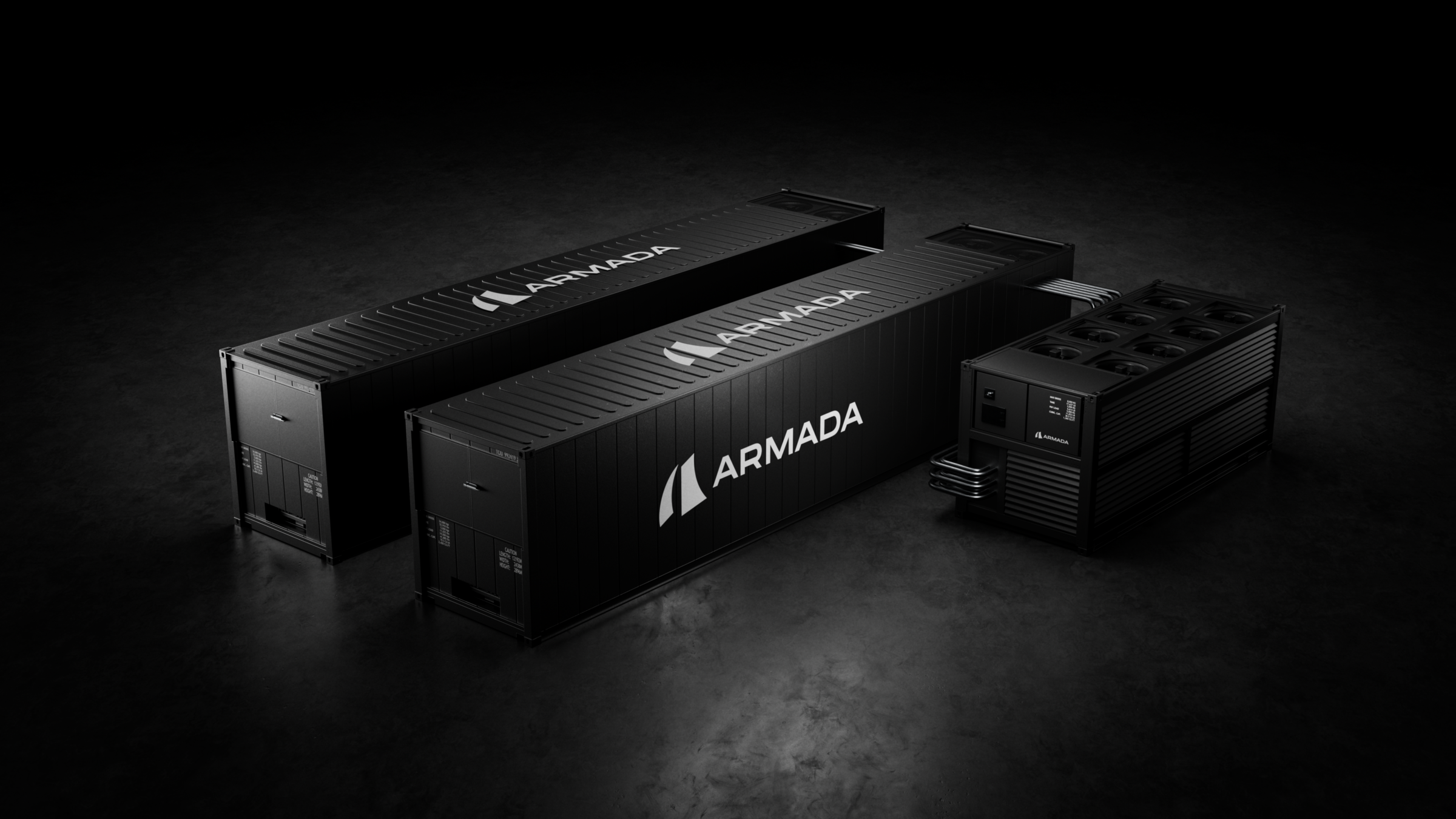
Every Armada unit ships as a turnkey solution, with the operating system, orchestration layer, and software stack already embedded. Customers plug them in and run workloads almost immediately. Armada layers in a growing ecosystem of native software, from remote asset management and fleet dashboards to GPU-as-a-Service, alongside third-party applications that run directly on the platform.
AI Infrastructure Meets National Security
What makes Armada particularly compelling is how naturally it sits at the intersection of commercial and defense use cases – otherwise known as dual-use technology. The use cases span some of the world’s most demanding industries: oil and gas, mining, telecom, public utilities, emergency services, and more.
Meanwhile, government and defense organizations increasingly need resilient, AI-driven computing for national security, disaster response, border protection, battlefield reconnaissance, military logistics, cyber defense, and other functions. Local compute is critical to operate these functions. Additionally Sovereign AI initiatives across the world are increasing the need for nationally controlled compute infrastructure to keep sensitive data and models secure even when operating missions abroad.
A World-Class Set of Strategic Partnerships and Collaborations
Few infrastructure companies have built an ecosystem this quickly. OpenAI, for instance, has selected Armada to collaborate on delivering smaller, industry-specific AI models designed to address operational challenges across critical sectors. Armada’s collaboration with Starlink creates a powerful flywheel: as more of the world gets connected, more of the world needs compute sitting next to where that connectivity terminates. Armada continues to expand its ecosystem and Marketplace through partnerships and collaborations with companies including Microsoft, NVIDIA, Palantir and Dell Technologies. This kind of forward-thinking go-to-market strategy is exactly what we look for at NightDragon.
A Team Built to Scale
Armada is led by a team that has built and scaled enterprise software businesses before. CEO Dan Wright was previously CEO of AppDynamics, President John Runyan helped take Okta public, and their founding CTO Pradeep Nair spent a decade leading infrastructure at Azure. These are leaders who have written a high-trajectory growth story before and are putting those lessons into practice to now grow Armada.
This team is backed up by a powerful set of investors. The Series B round was co-led by Overmatch, BlackRock, and 8090 Industries and also included new strategic investors Johnson Controls, NightDragon, Mitsui, and Singtel Innov8, as well as existing investors Felicis, Marlinspike, Shield Capital, Lux Capital, Founders Fund, Veriten, and Gladebrook.
Extending NightDragon’s SecureTech Thesis
Our investment in Armada is a natural extension of the thesis we’ve been building across the firm around securing our world for tomorrow. We’ve backed Saronic in maritime autonomy, Forterra in ground autonomy, Starfish in space, Epirus in counter-drone and directed energy, and Horizon3.ai in autonomous cyber. We also backed HawkEye 360 and Capella Space, two satellite companies that have exited through IPO and M&A in the past year. Armada fits naturally into this investment story as a key infrastructure component of AI.
The competitive landscape today is fragmented. Plenty of vendors sell hardware, but few deliver a turnkey platform with the software depth, partnerships, and operational rigor Armada has assembled. We believe Armada has a real opportunity to define this category and enable important missions and functions worldwide.
We’re thrilled to partner with Dan, John, and the entire Armada team as they bring AI compute to places it has never been able to reach. We strongly believe in the mission and look forward to partnering to achieve it.
About the Author