NightVision Interview | Part 3 of 4 | Recorded live at Black Hat 2026, Las Vegas
THE TAKEAWAY
Katie Sutton, Assistant Secretary in the Department of War overseeing cyber policy, joined NightDragon Founder & CEO Dave DeWalt at Black Hat 2026 — her first Black Hat — to detail how the department is integrating cyber into every warfighting domain rather than treating it as an isolated function, building specialized and purpose-built cyber forces, and shifting public-private partnership away from reactive information-sharing and slow tool acquisition toward outcome-based collaboration with industry.
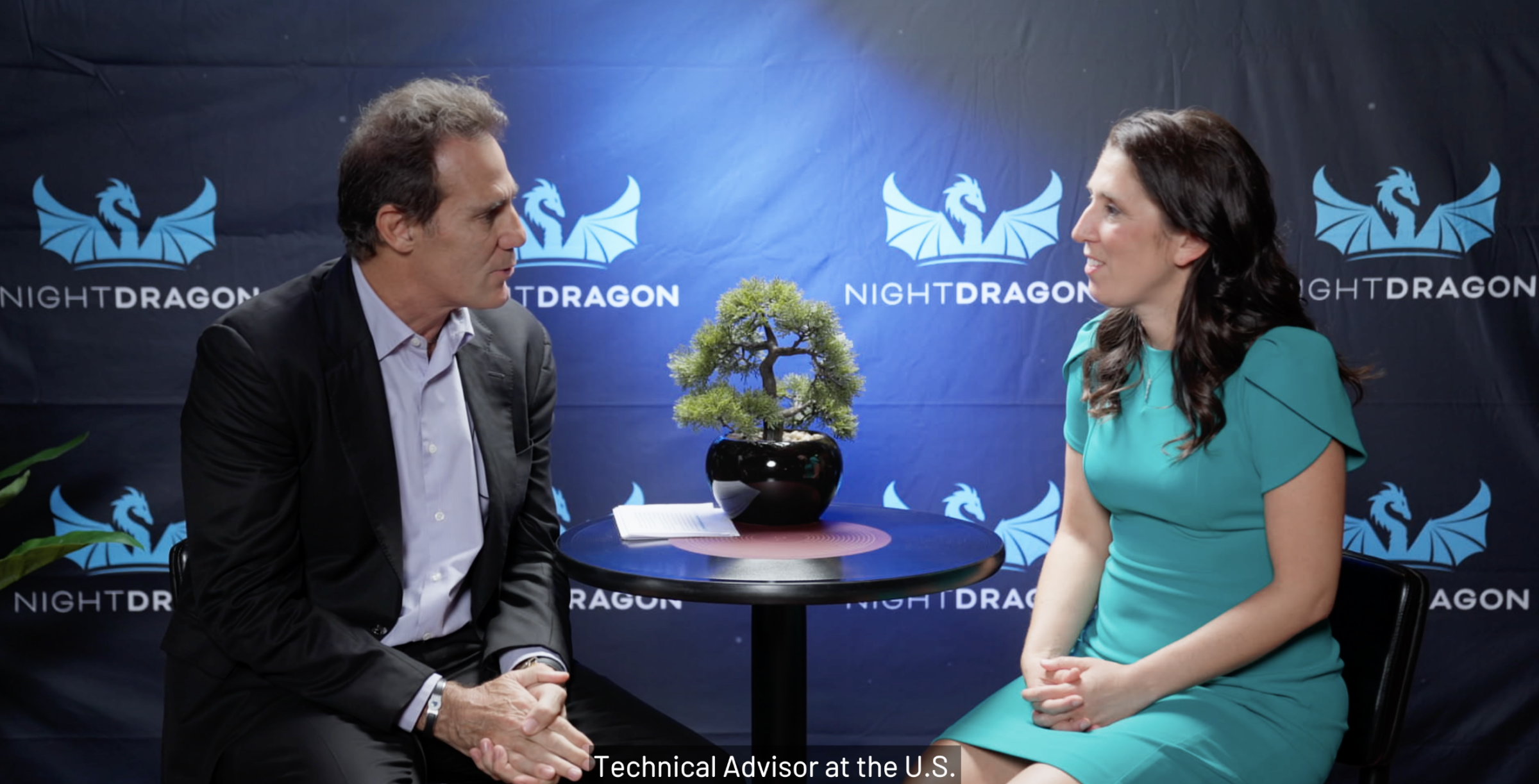
Speaking with Dave DeWalt at Black Hat 2026, Katie Sutton, Assistant Secretary in the Department of War, laid out how the department is rethinking cyber as a warfighting tool, a workforce challenge, and a partnership model, all at once.
What is the Department of War’s top cyber priority right now?
Sutton said the department is laser-focused on one overarching goal: giving the president and secretary the most robust set of cyber capabilities available to provide strategic advantage, protect the nation, and defend the homeland. To get there, her team is focused on three things: integrating cyber across every warfighting domain, building strategic advantage in cyberspace, and rebuilding the cyber workforce around specialization and agility.
How is cyber being integrated into military operations?
Historically, Sutton said, cyber was treated as its own stovepipe — largely a backstage IT function used to counter other cyber actors. That’s changing: cyber is now built into the kinetic and non-kinetic planning of military campaigns from the start. She pointed to Operation Absolute Resolve, the operation to capture Nicolás Maduro, as a first-of-its-kind example — cyber was planned in from the beginning, and the Chairman publicly credited how integral it was to the operation’s success.
“We have seen what cyber can really bring to our fight and what the vision of cyber warfare is in the future.”
Katie Sutton, Assistant Secretary, Department of War
What does it mean to make U.S. networks “hostile territory” for adversaries?
Per the Cyber Strategy for America, the department is shifting from a reactive, tactical posture to a strategic one. Rather than simply detecting and responding to breaches after the fact, Sutton said the goal is to make U.S. infrastructure and critical resources genuinely costly for adversaries to attack — a clear, standing consequence rather than an occasional response.
How is the department rethinking its cyber workforce?
Sutton framed talent, not technology, as the department’s best tool. That means pursuing real domain mastery and specialization. It also means agility: rather than one uniform cyber force deployed against every problem, the department is organizing purpose-built teams matched to specific mission sets, since no two cyber fights look the same.
What is the Cyber Innovation Warfare Center?
As part of the department’s Cyber Command 2.0 initiative, the Cyber Innovation Warfare Center has two halves. The “innovation” side is a front door for industry and a way for operators to partner directly with companies and rapidly experiment with new tools, without getting bogged down in a slow acquisition process. The “warfare center” side looks at the non-material changes new tools demand: training, data, doctrine, and tactics, techniques, and procedures. Sutton’s framing: AI won’t just make existing workflows faster, it will change how operators fight altogether.
How is public-private partnership changing under this strategy?
Sutton described two historical lanes for public-private cyber partnership: reactive information sharing, and buying tools through a slow acquisition process that often left them outdated by the time they reached operators. The department’s new focus is on outcomes and partnering with industry to define the result needed and operationalizing it together, since the private sector builds and operates the very digital terrain the department fights on. She singled out AI as the clearest example of why tapping America’s private innovation ecosystem quickly is now a strategic necessity.
Watch the Full Interview
About NightVision
NightVision is NightDragon’s ongoing interview series, hosted by Founder & CEO Dave DeWalt, featuring conversations with the government, military, and industry leaders shaping cybersecurity, defense, and national security. This is the third in a special four-part series with the leaders our nation has entrusted with its cyber defense. New episodes are available on the NightDragon site, YouTube, Apple Podcasts, Spotify, and Amazon Music.